

From Copilot to the agentic mid-market
Five levels for moving AI from personal productivity to accountable business capability, for mid-market organisations in Australia and New Zealand.
White paper · 41 pages · PDF · Free: the first 5 pages here, the rest with your work email
- Decide what AI may see: the sources it draws on, who owns each one and how current it must be.
- Decide what AI may do: the highest action each agent may take, with a control for every step up.
- Decide who answers for it: a named business owner, a record of what it did and a way to stop it.
About 45 minutes in full. For the short version, read pages 2, 4, 12 and 34.
~50%less onboarding administration at a multi-site aged care provider, from fixing the integration beneath its paperwork (page 4).
From Copilot to the agentic mid-market
Page 1 of 41
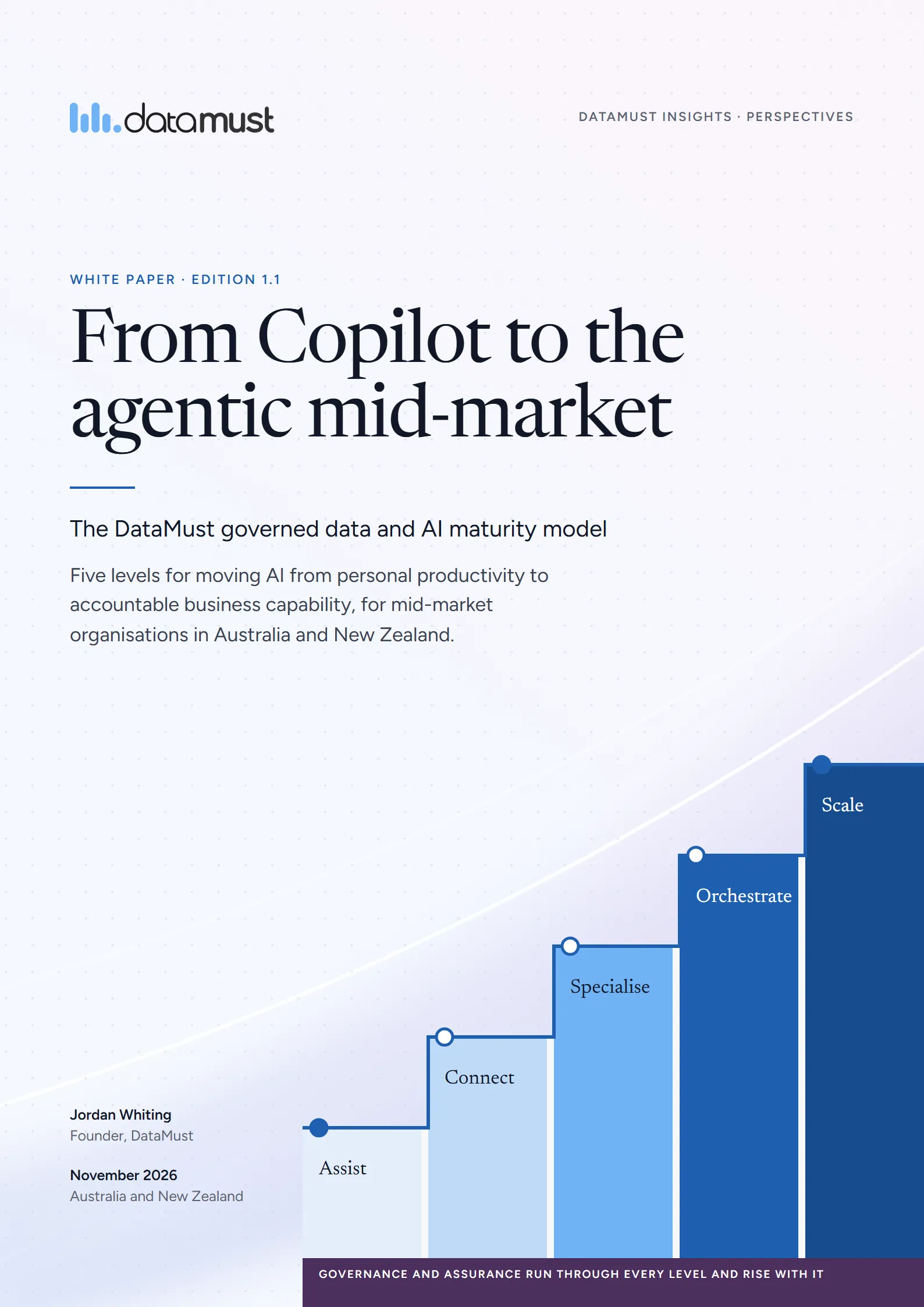
White paper · Edition 1.1
From Copilot to the agentic mid-market
The DataMust governed data and AI maturity model
Five levels for moving AI from personal productivity to accountable business capability, for mid-market organisations in Australia and New Zealand.
Jordan Whiting
Founder, DataMust
November 2026
Australia and New Zealand
After Copilot comes governed capability
Many organisations have given their people AI assistants such as Microsoft 365 Copilot. Far fewer have given AI the trusted data, governed access and accountability it needs to change how work gets done. Three leadership decisions close that gap.
Decide what AI may see
Name the sources AI may draw on, who owns each one and how current it must be. Answers are only as good as their provenance.
Chapters 2 and 4
Decide what AI may do
Set the highest action each agent may take, from reading to acting within limits. Every step up the ladder needs a matching control.
Chapters 3 and 4
Decide who answers for it
Give every AI capability a named business owner, a record of what it did and a way to stop it, before it goes live.
Chapters 3 and 5
~50%
less onboarding administration at a multi-site aged care provider, from fixing the integration beneath its paperwork. From our work, page 4
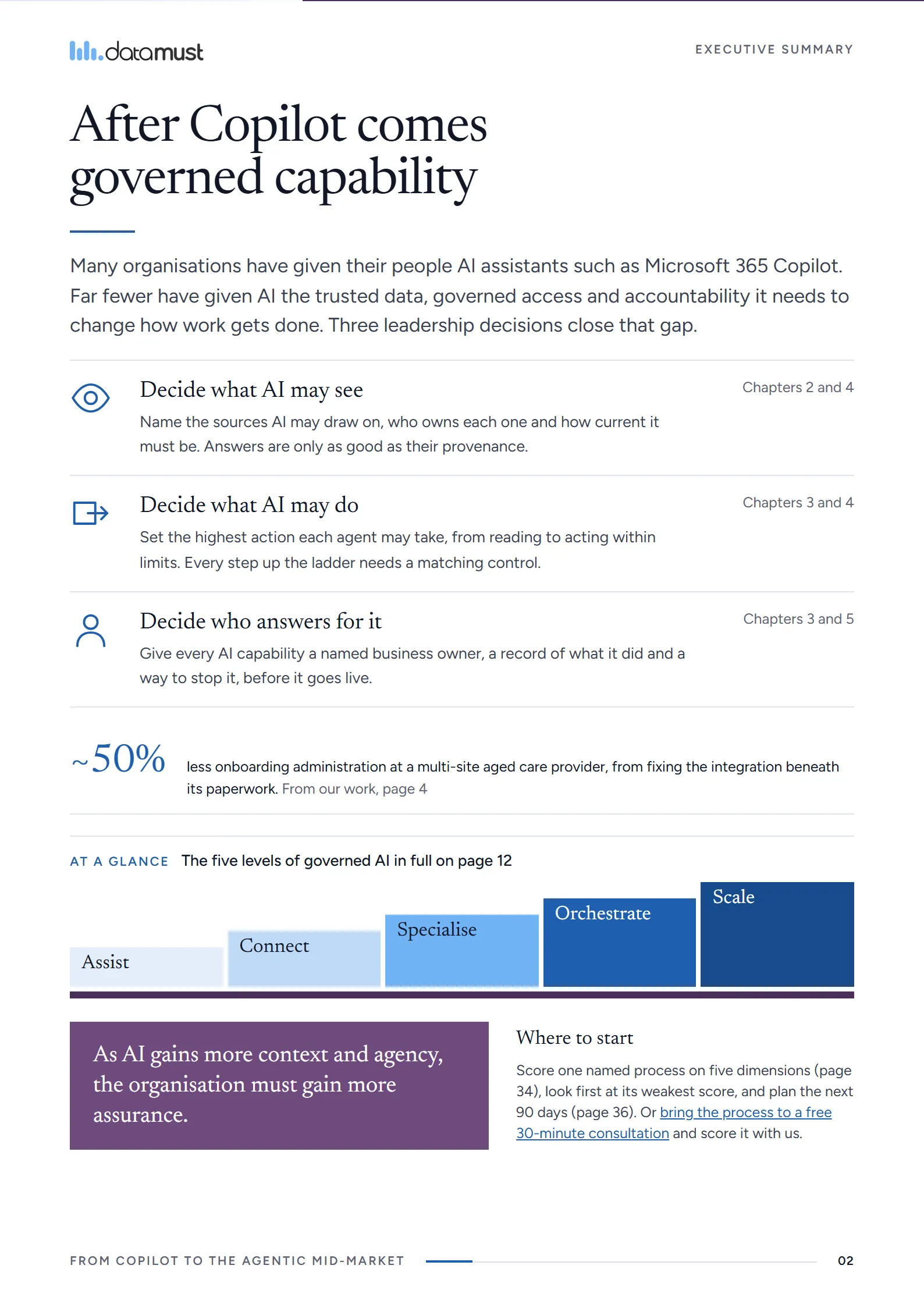
At a glance The five levels of governed AI in full on page 12
Assist
Connect
Specialise
Orchestrate
Scale
As AI gains more context and agency, the organisation must gain more assurance.
Where to start
Score one named process on five dimensions (page 34), look first at its weakest score, and plan the next 90 days (page 36). Or bring the process to a free 30-minute consultation and score it with us.
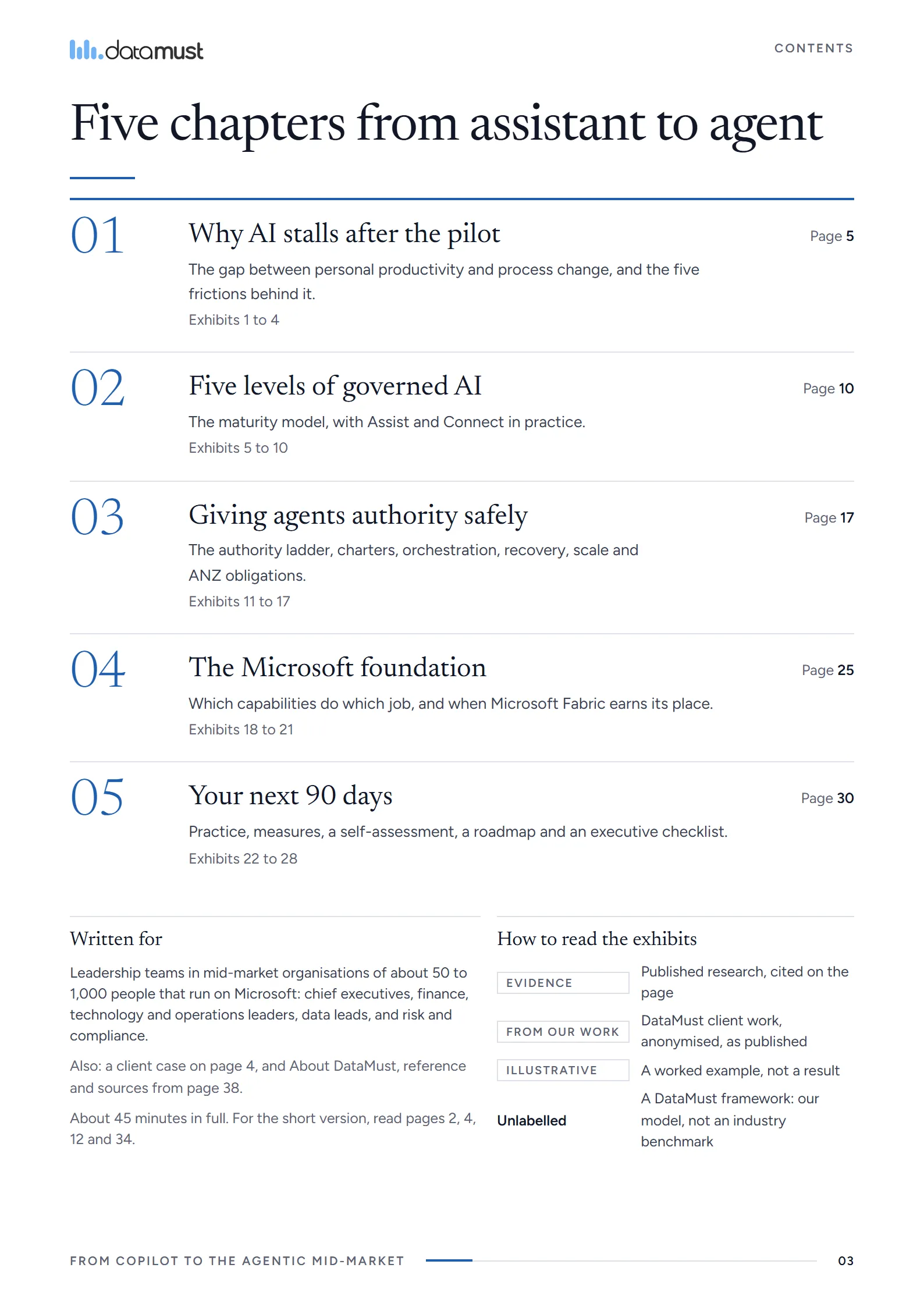
Five chapters from assistant to agent
01
Why AI stalls after the pilot
The gap between personal productivity and process change, and the five frictions behind it.
Exhibits 1 to 4
Page 5
02
Five levels of governed AI
The maturity model, with Assist and Connect in practice.
Exhibits 5 to 10
Page 10
03
Giving agents authority safely
The authority ladder, charters, orchestration, recovery, scale and ANZ obligations.
Exhibits 11 to 17
Page 17
04
The Microsoft foundation
Which capabilities do which job, and when Microsoft Fabric earns its place.
Exhibits 18 to 21
Page 25
05
Your next 90 days
Practice, measures, a self-assessment, a roadmap and an executive checklist.
Exhibits 22 to 28
Page 30
Written for
Leadership teams in mid-market organisations of about 50 to 1,000 people that run on Microsoft: chief executives, finance, technology and operations leaders, data leads, and risk and compliance.
Also: a client case on page 4, and About DataMust, reference and sources from page 38.
About 45 minutes in full. For the short version, read pages 2, 4, 12 and 34.
How to read the exhibits
Evidence Published research, cited on the page From our work DataMust client work, anonymised, as published Illustrative A worked example, not a result Unlabelled A DataMust framework: our model, not an industry benchmark
The fix sat beneath the paperwork
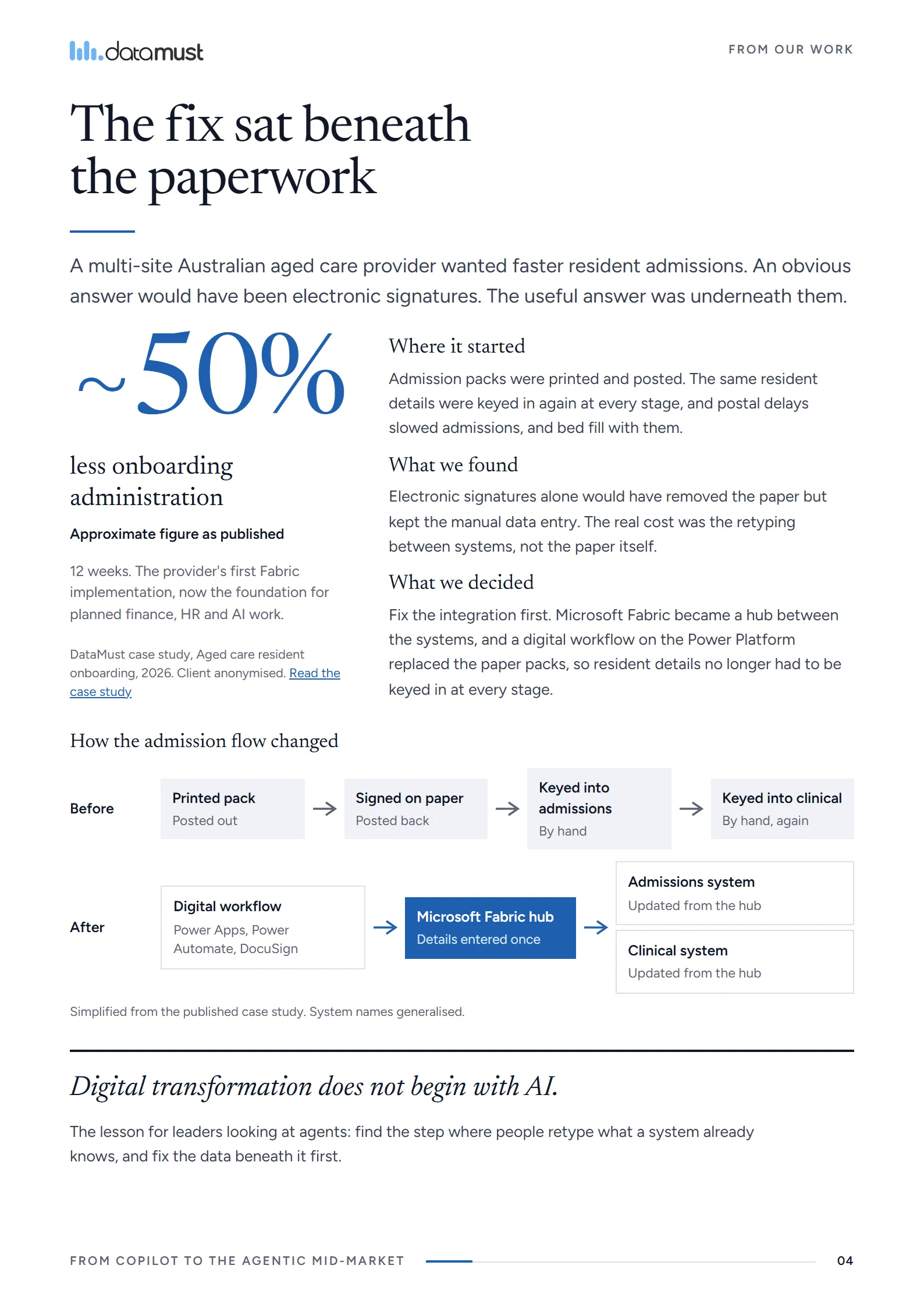
A multi-site Australian aged care provider wanted faster resident admissions. An obvious answer would have been electronic signatures. The useful answer was underneath them.
~50%
less onboarding administration
Approximate figure as published
12 weeks. The provider's first Fabric implementation, now the foundation for planned finance, HR and AI work.
DataMust case study, Aged care resident onboarding, 2026. Client anonymised. Read the case study
Where it started
Admission packs were printed and posted. The same resident details were keyed in again at every stage, and postal delays slowed admissions, and bed fill with them.
What we found
Electronic signatures alone would have removed the paper but kept the manual data entry. The real cost was the retyping between systems, not the paper itself.
What we decided
Fix the integration first. Microsoft Fabric became a hub between the systems, and a digital workflow on the Power Platform replaced the paper packs, so resident details no longer had to be keyed in at every stage.
How the admission flow changed
Before
Printed pack
Posted out
Signed on paper
Posted back
Keyed into admissions
By hand
Keyed into clinical
By hand, again
After
Digital workflow
Power Apps, Power Automate, DocuSign
Microsoft Fabric hub
Details entered once
Admissions system
Updated from the hub
Clinical system
Updated from the hub
Simplified from the published case study. System names generalised.
Digital transformation does not begin with AI.
The lesson for leaders looking at agents: find the step where people retype what a system already knows, and fix the data beneath it first.
01
Why AI stalls after the pilot
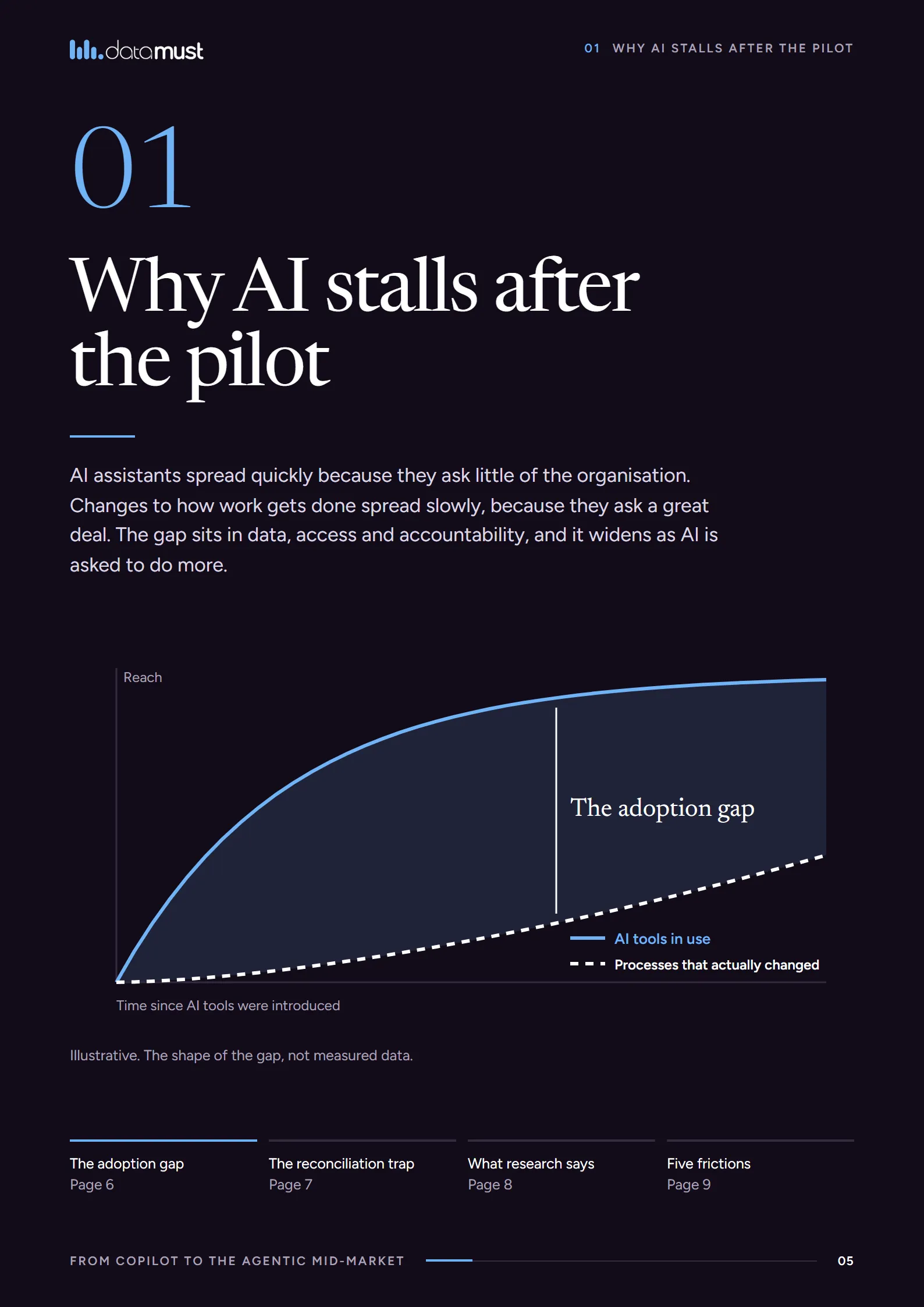
AI assistants spread quickly because they ask little of the organisation. Changes to how work gets done spread slowly, because they ask a great deal. The gap sits in data, access and accountability, and it widens as AI is asked to do more.
Illustrative. The shape of the gap, not measured data.
The adoption gap
Page 6
The reconciliation trap
Page 7
What research says
Page 8
Five frictions
Page 9

Pages 6 to 41
Read the rest of the guide
Enter your work email to open pages 6 to 41 here and download the PDF.